- 01 A small front garden with a big problem
- 02 Why weathering steel (corten) was the right material for this project
- 03 Corten and Cornish stone: a natural pairing
- 04 How the sunken courtyard was designed and built
- 05 Using Rigidline steel edging panels as step risers
- 06 Rigid profile for step risers — why it matters
- 07 The feature planter: Fixed Height Line in action
- 08 What made this project work
- 09 Corten in wet climates
- 010 Common questions about steel garden edging steps
A small front garden with a big problem
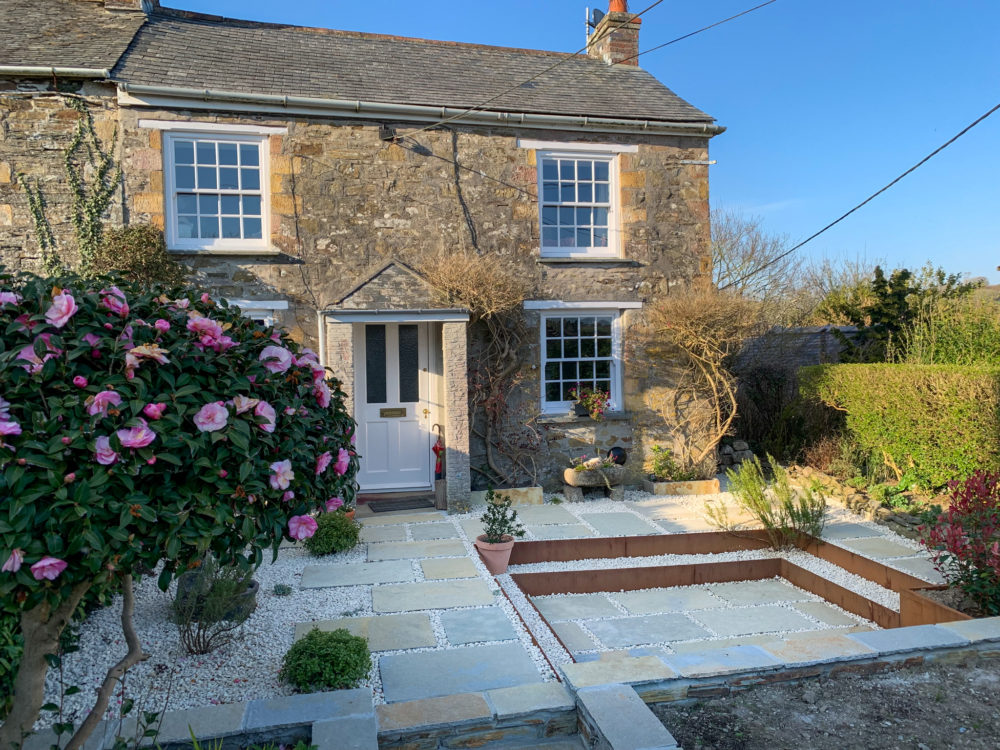
Small front gardens on sloping plots present a familiar challenge: a level change that turns a potentially inviting entrance into a cramped corridor, well planted but not working as a space. That was the starting point for this Cornish cottage project — a front garden with real character but untapped potential.
The solution was a sunken courtyard using weathering steel, known widely as corten steel, for both the step risers and a feature planter. The result is a contemporary finish that works with the warm yellows and rusty reds of Cornish stonework rather than against them. It also shows how versatile corten steel garden edging can be beyond its most familiar application as lawn edging.
This case study covers how the project was designed, which Straightcurve products were used and why, and what any gardener or landscaper working with a sloping front garden can take from it.
Quick Summary
A Cornish landscaper used Straightcurve weathering steel panels — Rigidline for the step risers and Fixed Height Line for a feature planter — to transform a cramped, sloping front garden into a private sunken courtyard. The corten steel complemented the local stonework, required no fabrication or welding, and was installed without specialist tools. This case study covers the design approach, product choices, and the practical lessons worth applying to any similar project.
Why weathering steel (corten) was the right material for this project
Material choice in a front garden project has to satisfy three things at once: structural performance, weather resistance, and visual fit with the surrounding architecture. For this Cornish cottage, weathering steel delivered on all three.
Corten steel develops its characteristic warm, rust-toned surface through a natural oxidation process driven by contact with air and moisture. Unlike untreated mild steel, the patina that forms is stable and adherent — it significantly slows further corrosion rather than accelerating it. The material manages rust by design. The UK’s temperate maritime climate suits this process well. Regular rainfall followed by dry periods provides the wet-dry cycle weathering steel needs to develop and maintain its protective surface, and Cornwall’s high rainfall is not a concern for an inland garden installation.
The visual case for corten here is equally straightforward. The warm orange-brown tones the material develops mirror the iron-rich colouration found in Cornish granite and local stonework. This is not a contemporary material dropped into a traditional context — it belongs there.
Pro Tip
Corten and Cornish stone: a natural pairing
Weathering steel develops tones that closely mirror the iron-rich colouration found in Cornish granite, local stonework, and limestone. If your project involves natural stone walls, dressed granite, or sandstone paving, corten steel is one of the few modern materials that complements rather than competes with the palette around it.
How the sunken courtyard was designed and built
The brief was to create a place to sit that made use of the garden’s sunny aspect without feeling exposed to the lane below or the surrounding houses. Rather than levelling the slope and fighting the level change, the landscaper used it: sinking a small paved area close to the house to create privacy through enclosure.
The paving chosen was limestone, laid with wide joints filled with limestone chippings. The wide joints allow creeping plants to establish between the slabs over time, softening the edges and reducing the maintained feel of the space. It is a practical detail that suits the cottage setting and means less work as the garden matures.
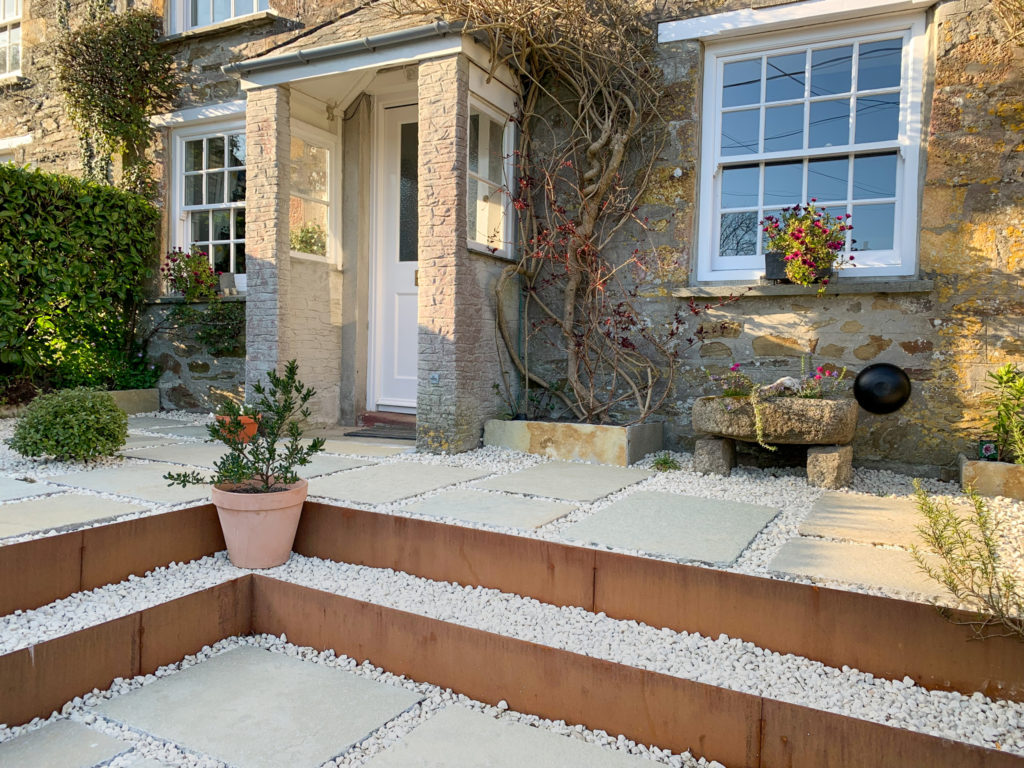
The weathering steel edging defines the transition between levels throughout the scheme, forming the risers of the steps down into the sunken area and holding the edges of the feature planter in place. That dual role is central to why steel edging suits this kind of project: it functions as both structural element and finish detail without requiring separate framing, capping, or cover materials.
Using Rigidline steel edging panels as step risers
For the step risers, the landscaper specified Straightcurve Rigidline garden edging panels at 240mm height. The choice of the rigid profile was deliberate. Steps need panels that hold their position exactly under repeated load, with no flex or movement over time. Flex profiles are designed for curves; Rigid profiles are designed for straight lines that stay straight.
Straightcurve Rigidline panels connect using a pre-attached connector plate, secured with Tek screws. The join sits internally between panels, keeping the outer face clean and continuous with no visible fixings. Panels arrive flat-packed and are assembled on site progressively, which means alignment can be checked and adjusted as the work progresses. A cordless drill is the most specialist tool required.
The 240mm height works for standard step dimensions and, in this project, was chosen specifically because it allowed each riser to be formed without encroaching on the surrounding path. On a narrow sloping entrance where every centimetre of clearance counts, that efficiency mattered. The finished steps are straight, sturdy, and precise enough to sit alongside dressed limestone paving without looking like a workaround.
Pro Tip
Rigid profile for step risers — why it matters
When using steel panels as step risers, the rigid profile is the right choice. Steps need the panel face to stay flat and the edge to stay sharp under repeated foot traffic. The structural stiffness of the Rigid profile is what maintains that precision over time. Flex profiles are for curves; save them for borders and tree rings.
The feature planter: Fixed Height Line in action
Alongside the steps, the project included a feature planter built from Straightcurve Fixed Height Line panels at 400mm height. Fixed Height Line is the zero-flex profile in the raised garden bed range, designed for above-ground applications where maximum rigidity is required. The panels form a clean, upright face with no forward lean or movement under soil pressure.
Like the Rigidline edging used for the steps, Fixed Height panels connect via connector plate and Tek screws and arrive flat-packed for straightforward on-site assembly. No welding, no fabrication, no specialist subcontractors.
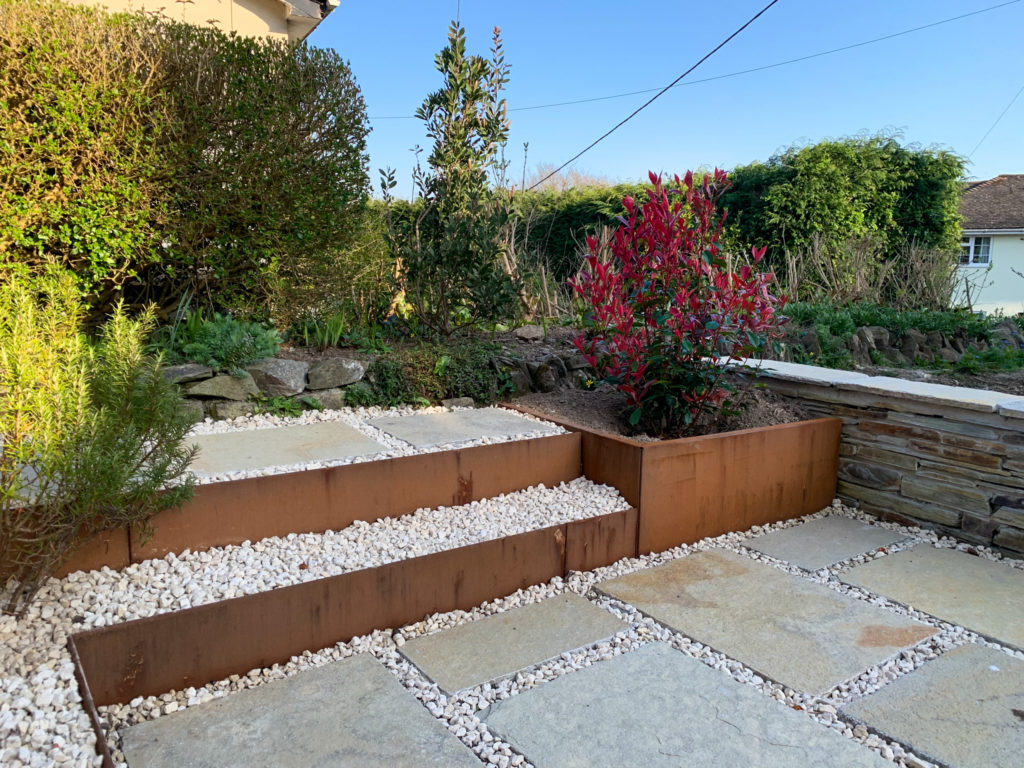
The planter provides planted height at the edge of the sunken courtyard, adding vertical interest without a masonry wall and creating a planted buffer that contributes to the sense of enclosure the brief required. Because both the steps and the planter are built from the same Straightcurve system, the steel panels share the same profile, the same patina development, and the same finish. The visual consistency is what makes the project read as a considered design rather than a collection of separate decisions.
What made this project work
A few things distinguish this project from a standard front garden makeover, and most of them are transferable to other sloping plots.
The level change was used rather than fought. Many sloping front gardens are levelled at considerable cost and effort to create a flat surface. Here the level difference became the design opportunity. The drop created the sunken enclosure that gives the space its character and its privacy.
The material palette was kept tight. Limestone paving, limestone chippings, local stonework, and corten steel — four materials, all working in the same warm tonal range. A restricted palette is what makes a small garden feel deliberate rather than cluttered.
The edging did double duty. Steel panels formed the step risers, the planter walls, and the finish detail of the courtyard edges simultaneously. When one material can take on multiple structural and aesthetic roles, it reduces both cost and visual complexity.
Installation stayed within standard trade skills. No welding, no fabrication, no specialist equipment. Panels assembled on site with a cordless drill, progressively, with alignment adjusted as the work moved forward. For a project of this scale, keeping installation accessible is what makes the economics work.
If you are a landscaper working on projects like this, a Straightcurve PRO account gives you access to trade pricing and the full product range.
For more on how steel garden edging is being used in award-winning garden design across the UK, see our piece on the techniques professional landscapers rely on.
Pro Tip
Corten in wet climates
The UK climate is well suited to weathering steel. The regular wet-dry cycles that Cornwall and much of the UK experience are exactly the conditions the material needs to develop and maintain its stable protective patina. For coastal locations within roughly 2km of the sea, where persistent salt air can interfere with patina formation, galvanised steel is the more reliable choice. For inland gardens, weathering steel performs consistently in British conditions.
Our Longevity Guide and Product Care Guide cover the specific steps that make the most difference in coastal and challenging environments.
Common questions about steel garden edging steps
Can you use steel garden edging as step risers?
Yes. Straightcurve Rigid garden edging panels are well suited for use as step risers. The rigid profile holds a straight, flat face under repeated load; the 240mm height works for standard step dimensions; and the panels connect using a pre-attached connector plate secured with Tek screws, giving a clean finish without visible fixings. No welding or fabrication is required. This Cornish front garden project used exactly this approach for a sunken courtyard with multiple steps.
What is weathering steel and why is it used in garden design?
Weathering steel, also known as corten steel, is a steel alloy that develops a stable, rust-toned surface patina through exposure to moisture and air. Rather than corroding progressively like untreated mild steel, the patina forms a coherent layer that significantly slows further oxidation. In garden design it is valued for this durability and for its warm, earthy appearance, particularly in settings with natural stone, timber, or planted contexts where a contemporary material is wanted without cold, industrial aesthetics.
Is corten steel garden edging suitable for the UK climate?
Yes. The UK’s temperate maritime climate suits weathering steel well. Regular rainfall followed by dry periods provides the wet-dry cycle that allows a stable patina to develop. High-rainfall areas including Cornwall are not a concern for inland installations. The main exception is coastal locations within approximately 2km of the sea, where persistent salt air can interfere with stable patina formation. In those conditions, galvanised steel garden edging is the more reliable option. Our Longevity Guide and Product Care Guide cover detailed guidance on installation and care in coastal and challenging environments.
How are Straightcurve panels joined without welding?
Straightcurve panels connect using a pre-attached connector plate, secured with Tek screws or stainless rivets as an alternative. The connector plate sits internally between panels, keeping the join discreet and the outer face clean. Assembly requires only a cordless drill. No welding, no fabrication equipment, and no specialist skills. Panels are assembled progressively on site, which allows alignment to be checked and adjusted as the installation moves forward.
Can I set up a trade account to buy Straightcurve products?
Yes. Straightcurve offers a PRO account for landscape professionals, giving access to trade pricing and the full product range. You can apply online and the team will be in touch to complete the setup.