- 01 Why metal garden edging is the landscaper's first choice
- 02 Corten steel and weathering steel edging for timeless garden borders
- 03 Corten steel and coastal gardens
- 04 Flex steel edging for beautiful curved pathways
- 05 Raised steel planters for feature planting
- 06 No digging required
- 07 Zero-Flex edging as a crisp geometric divider
- 08 Steel rings for stepped and multi-level garden access
- 09 Which steel garden edging is right for your project?
- 010 Common questions about metal garden edging
Why metal garden edging is the landscaper's first choice
Well-designed gardens don’t happen by accident. Behind the clean lines, the sharp borders, and the effortless separation between lawn, path, and planting bed, there’s almost always one thing doing quiet, essential work: quality metal garden edging.
Steel garden edging (including corten steel edging and weathering steel) has become the material of choice for professional landscapers across the UK. It holds its shape over years rather than months, handles the UK’s wet climate without warping or cracking, and delivers a precision that timber, plastic, or concrete simply can’t match. For DIY gardeners looking to achieve the same results, Straightcurve’s modular system makes it genuinely achievable without specialist tools or skills.
Below are five ways landscapers use steel garden edging to define, organise, and elevate outdoor spaces, and how you can apply the same ideas in your own garden.
Quick Summary
Steel and corten garden edging is the tool professional landscapers reach for when they need clean, durable, long-lasting garden borders. This article covers five practical techniques (from curved Flex edging for flowing pathways to Zero-Flex panels for geometric precision) with guidance on which product suits each application. Whether you’re planning a new garden or refreshing existing borders, these ideas translate directly to DIY projects of any scale.
Corten steel and weathering steel edging for timeless garden borders
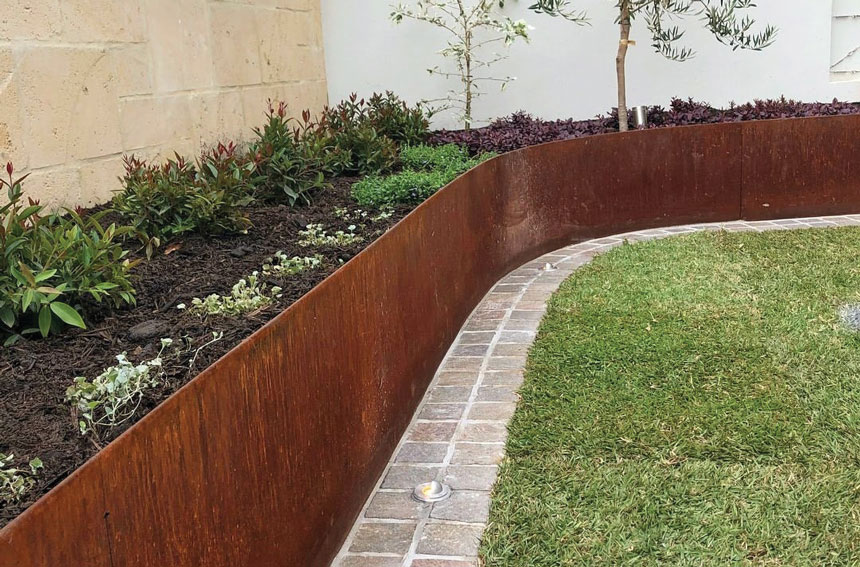
One of the most striking uses of metal garden edging is the above-ground border: a steel panel installed with 50–75mm visible above soil level, creating a bold, clean line between lawn and planting bed.
Corten steel, also known as weathering steel, develops its characteristic warm rust-coloured patina naturally over time as it reacts to the wet-dry cycle of the UK climate. Rather than looking aged or deteriorating, it develops a stable, self-protecting surface layer that actually makes the steel more durable as the years pass. The UK’s rainfall pattern (wet winters, drier summers) is well-suited to healthy patina development, making corten steel garden edging a particularly good choice for British gardens.
The warm rust tone sits naturally against mulch, gravel, ornamental grasses, and structural shrubs like lavender, rosemary, and hydrangea. It’s subtle enough to frame the garden without competing with planting, and robust enough to handle the soil movement and moisture that UK gardens experience year-round.
Straightcurve’s Flex edging in weathering steel is the right choice here, its natural flexibility allows it to follow long, sweeping curves by hand on site, creating flowing organic shapes without any cutting or fabrication. One length connects cleanly to the next using the integrated connector plate system.
Pro Tip
Corten steel and coastal gardens
For gardens within approximately 2km of the coast, or in areas with high salt exposure, weathering steel benefits from additional care as chloride can disrupt patina formation. Our Longevity Guide and Product Care Guide cover the specific steps that make the most difference. For those who prefer a lower-maintenance option in coastal locations, Straightcurve’s galvanised steel is a practical alternative, engineered for exactly these conditions.
Flex steel edging for beautiful curved pathways
Garden paths do more than get you from one place to another. A well-designed path guides the eye, creates a sense of movement, and establishes the rhythm of the garden. The edging that defines it shapes the entire experience.
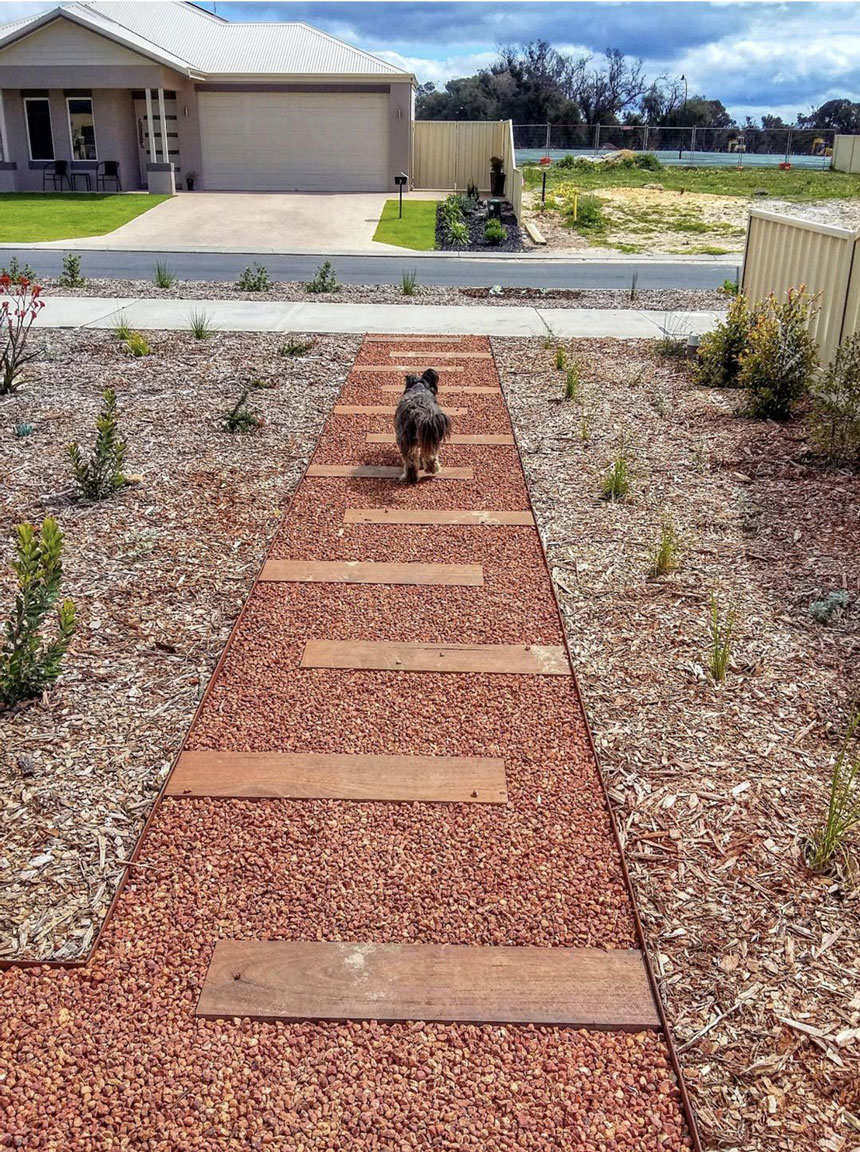
Flex steel edging is designed for exactly this application. Its notched profile allows it to curve smoothly in any direction, tight tree rings, sweeping lawn borders, or the gentle arcs that separate a gravel path from a planted bed. There’s no heat, no specialist equipment, and no fabrication required. You shape it by hand on site.
This is where metal garden edging genuinely outperforms every other material. Timber loses its shape at curves and eventually rots at ground level. Plastic cracks under UV exposure and frost. Flex steel holds its line for years, and in weathering steel or galvanised finish, it holds up to whatever the British climate delivers.
Practically, edged paths also serve safety functions: clearly defined edges guide you safely to a front door at night and define spaces for different surfaces (paving slabs, gravel, bark) to sit cleanly against each other without creep.
Raised steel planters for feature planting
Some plants deserve to be celebrated rather than just contained. Raised steel planters are the landscaper’s way of doing exactly that, lifting key feature plants above ground level to command attention, improve drainage, and make a planting bed a genuine focal point.
Straightcurve’s Raised Garden Bed panels are available in 240mm, 400mm, and 560mm heights, and use the same modular connector system as the in-ground edging range. Flex and Zero-Flex panels are join-compatible, so you can combine curved and straight sections in a single project, something that would require custom fabrication with any other system.
In weathering steel, raised planters develop the same warm corten patina as above-ground edging, tying the whole garden’s steel elements together visually. In galvanised steel, they’re suited to wetter positions or more exposed sites where weathering steel isn’t recommended.
The practical benefits go beyond aesthetics. Raised beds warm up earlier in spring, improve drainage for plants that dislike wet feet, and make it easier to maintain soil quality independently from surrounding ground. For UK gardens where clay-heavy soils are common, this is a meaningful advantage.
Pro Tip
No digging required
Straightcurve’s Raised Garden Bed panels have integrated locking feet, no trenching or buried installation needed. This significantly reduces installation time compared to traditional raised bed construction, and means the panels can be repositioned if your garden plan changes.
Zero-Flex edging as a crisp geometric divider
Not every garden is about curves. Formal gardens, contemporary designs, and driveways often call for straight lines, and that’s where Zero-Flex steel edging does its best work.
Zero-Flex panels are maximally rigid by design, making them the right choice wherever precise geometry is non-negotiable: straight path edges, driveway borders, the lines between a lawn and paving, or the boundary between two surface materials that need to stay exactly where you put them.
Beyond the visual precision, rigid steel edging performs a structural function. Installed at the edge of a path or driveway, it acts as a restraint for the surface material beside it, preventing gravel migration, stopping mulch from spreading onto paving, and providing a fixed edge for paving slabs to be laid against. It effectively doubles as a low retaining element, containing surface materials without requiring a full retaining wall.
Straightcurve’s Zero-Flex and Rigid panels are join-compatible with Flex edging, so a project that combines straight driveway runs with a curved garden border can be built from the same system throughout, no mixing of incompatible products.
Steel rings for stepped and multi-level garden access
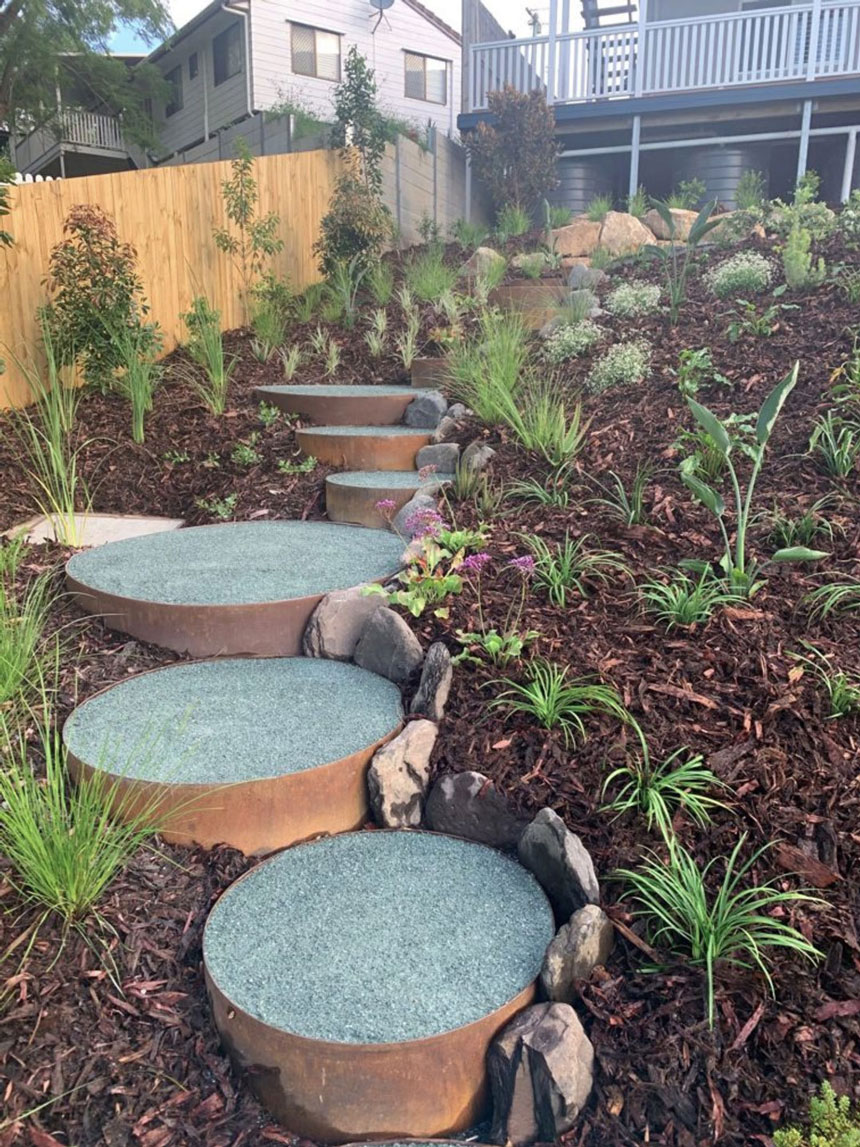
Sloping gardens present a design challenge that steel edging solves elegantly. Where ground rises across a garden, Flex steel panels can be formed into circular rings of varying diameters to create stepped access, a practical solution that looks considered and works for the long term.
Each level creates a flat, accessible surface. Filled with gravel or bark, the rings define each step clearly while containing the surface material. The weathering steel develops its corten patina in the same way as the rest of the garden’s steel elements, tying the steps visually into the broader scheme.
This application works particularly well in UK gardens where sloping lawns are common and timber sleeper steps (the traditional alternative) are subject to rot, frost heave, and eventual structural failure. Steel rings require no masonry, no concrete, and no specialist installation skills.
Which steel garden edging is right for your project?
The three core Straightcurve edging types each have a clear application.
Flex is designed for curved borders, tree rings, and organic shapes. Its notched profile bends smoothly by hand on site with no cutting, no heat, and no fabrication required. Available in weathering steel and galvanised.
Rigid handles straight runs with some gentle curvature. It suits formal borders, path edges, and any layout that is mostly straight but needs occasional flex. Available in weathering steel and galvanised.
Zero-Flex is the maximum-rigidity option, engineered specifically for perfectly straight lines: driveways, geometric garden designs, and long formal borders where alignment must stay exact. Available in weathering steel and galvanised.
Flex and Zero-Flex panels are join-compatible, so most projects use a combination. A garden with a curved lawn border and a straight path edge can use Flex for the border and Zero-Flex for the path, connected seamlessly within the same run.
For material choice: weathering steel (corten) is the right choice for most inland UK gardens with good drainage. For coastal locations within approximately 2km of the coast, weathering steel benefits from additional care — our Longevity Guide and Product Care Guide cover the specific steps. For those who prefer a lower-maintenance option in coastal locations, or where edging will be in sustained contact with organic material, galvanised steel is a practical alternative.
To find out which products suit your specific project and get pricing, request a price list from the Straightcurve UK team, or browse the garden edging range online.
Common questions about metal garden edging
What is the best metal garden edging for UK gardens?
Steel garden edging (either weathering steel (corten) or galvanised) is widely considered the best metal option for UK gardens. Weathering steel develops a self-protecting rust patina that stabilises over time and suits most inland gardens with reasonable drainage. Galvanised steel is the better choice for coastal locations or wetter, more challenging soils. Both outperform aluminium, which lacks rigidity, and plastic, which degrades under UV and frost. For a modular system that covers both straight and curved applications, Straightcurve’s Flex, Rigid, and Zero-Flex range is worth considering.
Does corten steel garden edging rust?
Corten steel (also called weathering steel) is designed to rust in a controlled way. The surface oxidises to form a stable, adherent patina layer that slows further corrosion beneath it. This is normal and intentional: the patina is the protection. What corten steel does not do is continue rusting through to structural failure under normal inland conditions. For coastal environments within approximately 2km of the sea, weathering steel benefits from additional care as salt exposure can disrupt patina formation. Our Longevity Guide and Product Care Guide cover the specific steps that make the most difference. For those who prefer a lower-maintenance option in coastal locations, galvanised steel is a practical alternative.
Can I use steel garden edging for curved garden borders?
Yes, Straightcurve’s Flex steel edging is specifically designed for curved applications. Its notched profile allows the panel to bend smoothly by hand on site, following any curve from a tight tree ring to a wide sweeping lawn border. No heat or specialist tools are required. For straight lines, Rigid and Zero-Flex panels are the correct choice. Flex and Zero-Flex are join-compatible, so a single project can combine both curved and straight sections using one system.