- 01 Gardening on a slope: the challenge and the solution
- 02 What makes steel edging ideal for sloping gardens
- 03 Galvanised vs corten on slopes
- 04 Case study: terracing a steep garden with corten steel (video)
- 05 Sloping garden design ideas: the full tour (video)
- 06 How to approach your sloping garden project
- 07 Weathering steel on UK slopes: a natural fit
- 08 Common questions about steel edging on slopes
Gardening on a slope: the challenge and the solution
A sloping garden is one of the most common challenges UK gardeners face, and one of the most rewarding to solve. Whether it’s a gently inclined back garden or a seriously steep plot, the problem is the same: soil erodes, water runs off, and flat planting space is hard to come by.
The good news is that corten steel and weathering steel edging have become one of the most practical and visually striking tools for tackling exactly this. The flexible panels can follow the contours of any slope, creating terraced levels, raised planting pockets, retaining edges, and even gravel-filled steps, without the need for traditional brick or timber retaining walls.
In this article, we’ve pulled together the core techniques for gardening on a slope, illustrated through a detailed case study from one of our Australian garden partners, plus practical guidance for planning your own sloping garden project.
Quick Summary
Corten steel (also known as weathering steel) edging is particularly well-suited to sloping gardens because its flexible panels can follow any gradient and hold soil at terraced levels without rigid foundations. This article covers the key design approaches (terracing, retaining, planting pockets, and gravel steps) and walks through a real example of a 33%-gradient garden transformed using Straightcurve Flex panels. A FAQ section at the end covers the most common questions about using steel on slopes.
What makes steel edging ideal for sloping gardens
Not all edging materials handle slopes well. Timber sleepers are heavy to work with on uneven ground and eventually rot where they contact soil. Concrete blocks require levelling and are difficult to curve. Plastic edging lacks the structural integrity to retain soil at any meaningful depth.
Steel edging (and in particular corten steel (weathering steel) addresses all three problems:
- Flexibility on uneven ground: Flex-profile steel panels bend to follow the natural contours of a slope. You shape the panel to the gradient rather than excavating to create a flat surface, a significant advantage when working on steep or irregular ground.
- Structural integrity for soil retention: Even at 400mm or 560mm height, steel raised bed panels hold their shape under soil pressure. On a slope, this matters, the retained soil on the uphill side exerts real lateral force, and the panel needs to hold it without bowing.
- Longevity in buried conditions: Any retaining or terracing application means the lower portion of the panel is buried in soil and likely in contact with moisture. Corten steel develops its characteristic patina above ground, but it also develops a degree of passive protection below ground through the same oxide layer formation process. For aggressive soils, galvanised steel is the recommended choice (more on that below).
Pro Tip
Galvanised vs corten on slopes
For most inland UK gardens, weathering steel (corten) is an excellent choice for terracing and retaining. However, if your soil is acidic (common in gardens with heavy compost or clay), or if you’re within 2km of the coast, galvanised steel is a practical alternative that provides consistent protection where corten’s patina formation can be disrupted. For detailed care guidance, see our Longevity Guide and Product Care Guide. Not sure which suits your site? Request our price list and brochure, it includes a material selection guide, or view the raised beds range online.
Case study: terracing a steep garden with corten steel (video)
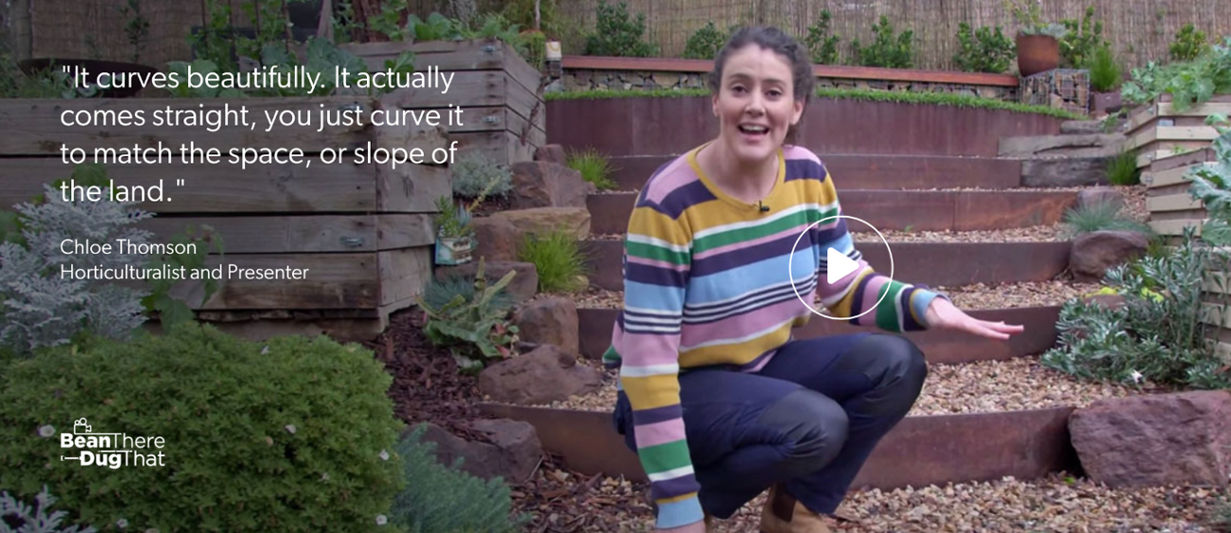
The best way to understand what’s possible on a sloping garden is to see it done. The following case study comes from a garden partner in Australia, a horticulturalist who transformed a 33%-gradient quarter-acre plot using Straightcurve Flex panels in weathering steel (corten). The same products, the same techniques, and the same principles apply equally to UK gardens.
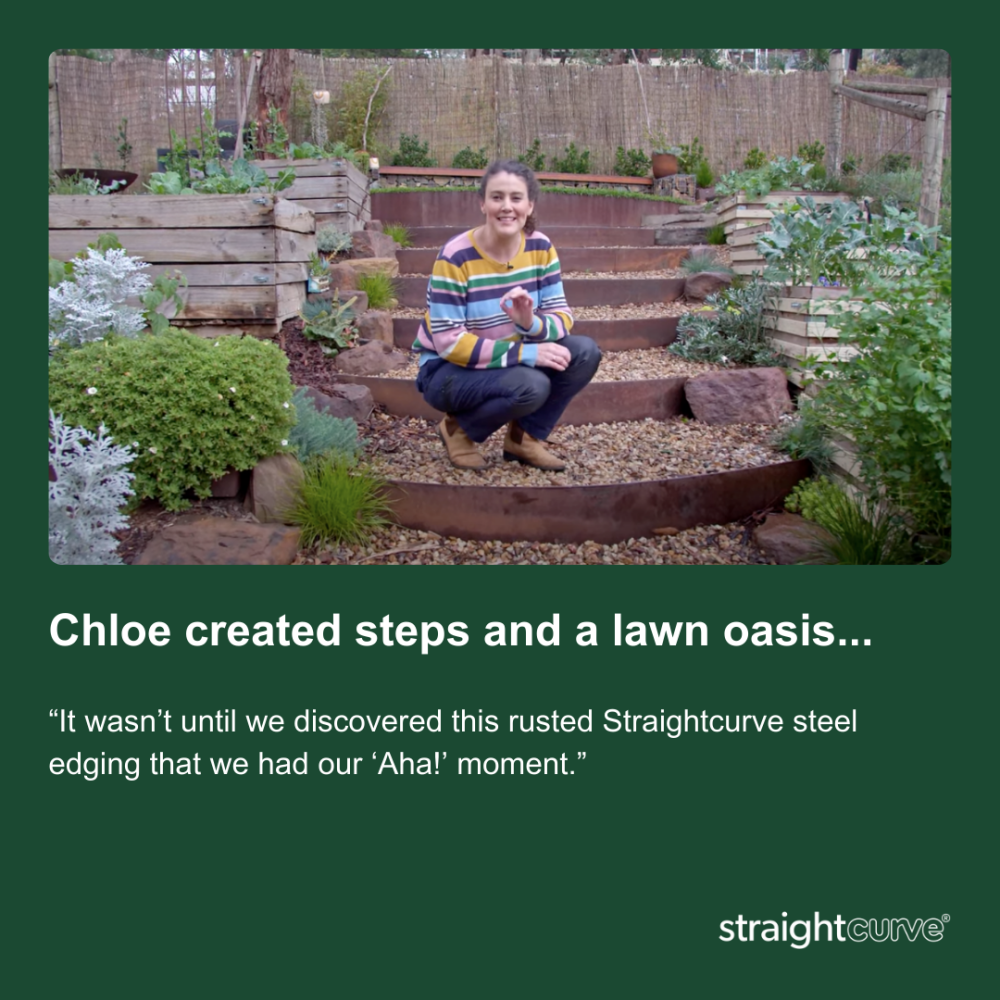
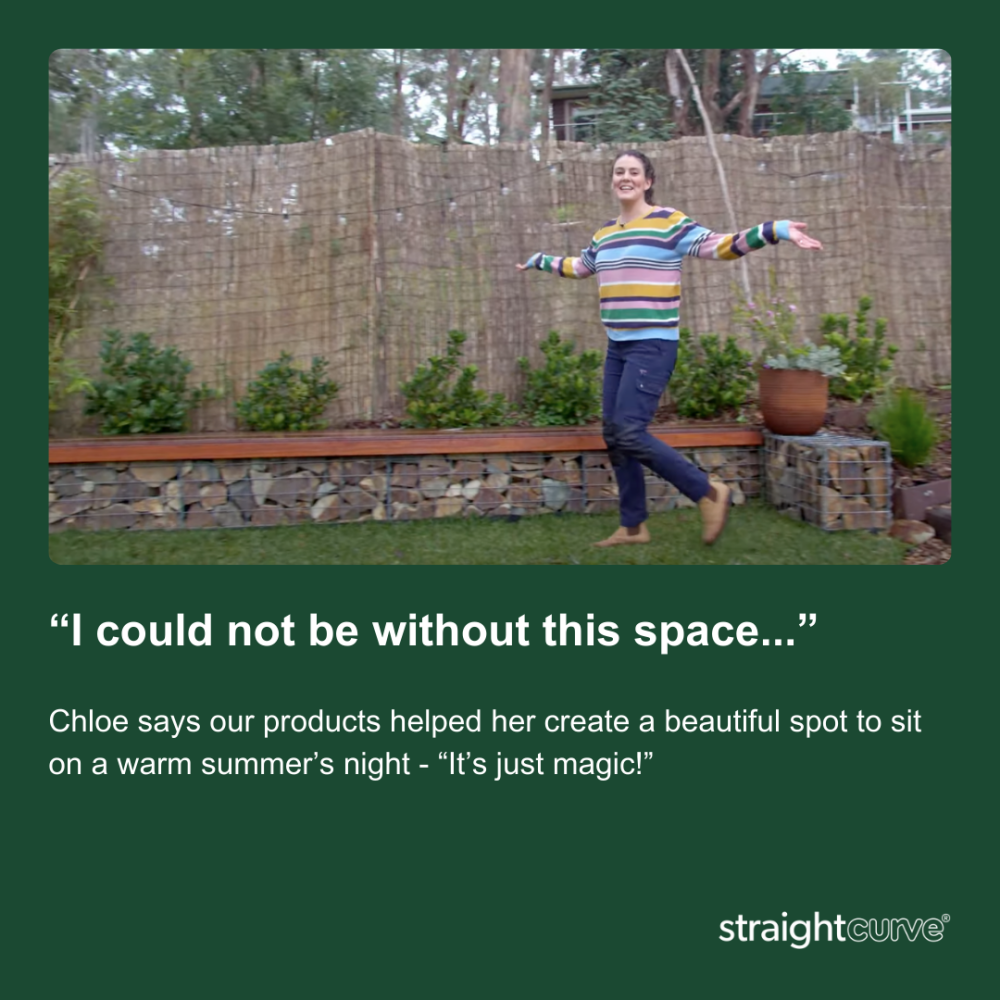
In this first video, she walks through the “very backyard” section (the steepest part of the property) explaining how she used flexible corten steel edging to create terrace-style steps leading up to a small lawn oasis:
“To tackle the 33% sloping backyard we used a very clever product called Straightcurve Edging, it’s a rusted steel edging (corten steel edging) that can be bent into any shape. So we’ve used it to create terrace style steps up to a small but lush green lawn. Don’t let a steep space stop you from successfully gardening on a slope!”
The key insight from this example: the steps were built incrementally, one level at a time, working up the slope. Each panel was shaped to follow the gradient and pinned in place before moving to the next. No specialist groundwork, no concrete foundations, just flexible steel panels and a methodical approach.
Sloping garden design ideas: the full tour (video)
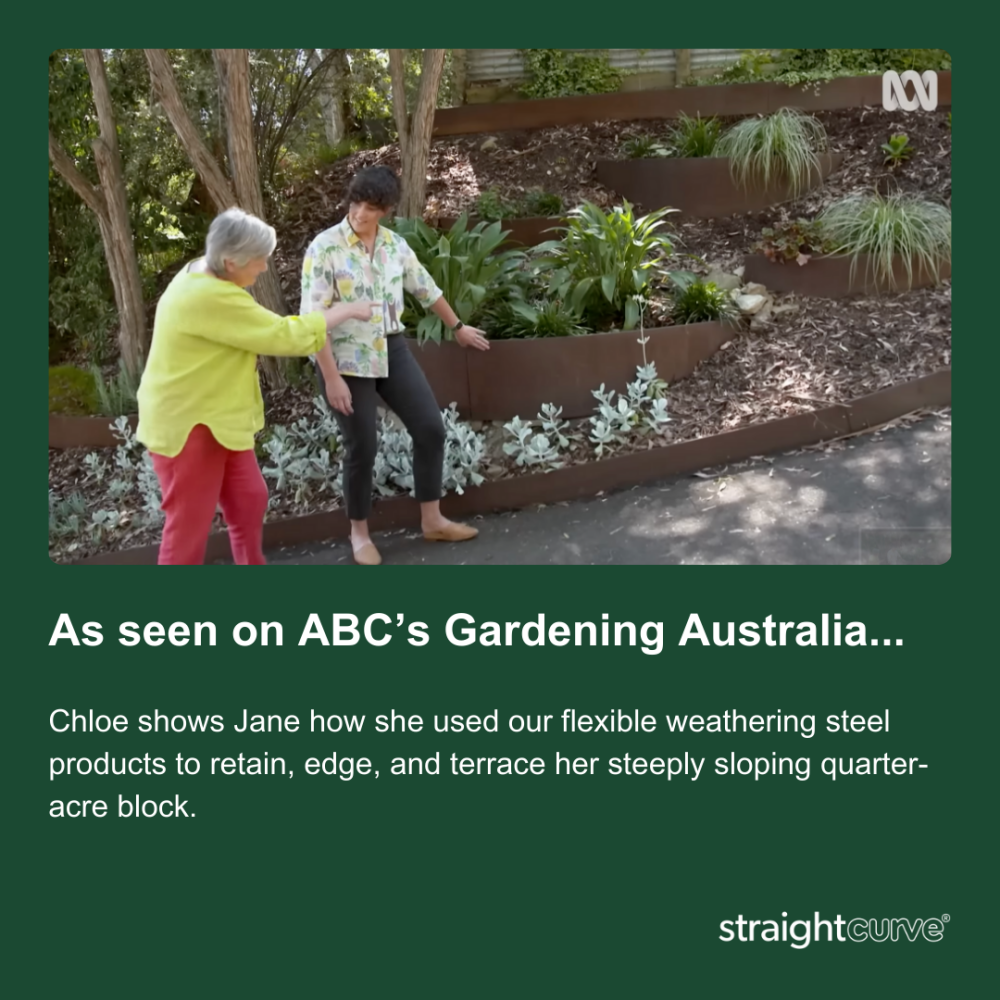
The second video covers the whole property, including the steeply-banked driveway, which presented a different kind of sloping challenge: getting plants to establish on a near-vertical bank alongside the drive.
The solution was flexible corten steel panels shaped to follow the slope, creating shallow planting pockets for succulents and ornamental grasses. The panels came flat, were bent on-site to match the bank angle, and developed their warm rust patina over time:
“These panels come flat (and they actually come black) and so you shape them to the slope and over time they rust to this beautiful colour.”
The video also covers gravel-filled steps built the same way, weathering steel panels shaped to hug each step rise, filled with gravel, built one step at a time up the slope.
“Look at different retaining options, look at ways you can create planting pockets or planting spaces. Things don’t have to be straight. I think people think too much that retaining walls and retaining soil needs to be all straight.”
How to approach your sloping garden project
Whether you’re dealing with a gentle incline or a steep bank, sloping garden projects broadly follow the same planning sequence.
1. Map your levels
Before ordering any materials, understand how much height change you’re working with across the plot. Even a rough sketch helps. The total height change determines how many terraced levels you’ll need and what panel heights are appropriate.
2. Decide on the approach
Three main options for steel edging on slopes:
- Terraced raised beds: horizontal panels stepped across the slope, creating level planting zones at each tier
- Retaining edges: panels set into the slope to hold soil at a defined edge (typically for paths, lawn edges, or driveway banks)
- Gravel steps: panels shaped as step risers, filled with compacted gravel or aggregate
3. Choose your panel height
For terracing and retaining on slopes, 400mm and 560mm raised bed panels are typically more appropriate than standard 75mm or 100mm edging, they need to hold meaningful volumes of soil. For step risers and light retaining, 100mm panels work well.
4. Work incrementally
As the case study above shows, there’s no need to tackle the whole slope at once. One terrace or one step at a time is a valid approach, and it makes the project manageable as a DIY job.
5. Plan your drainage
Sloping gardens naturally drain, which is often an advantage. But terraced levels can trap water if the base isn’t free-draining. Ensure each terraced planting area has adequate drainage material beneath the growing medium.
For a step-by-step walkthrough of building raised beds on a slope, our dedicated build guide covers panel heights, terracing approaches, and drainage in sequence.
For a full walkthrough of raised bed heights, materials, and panel selection, see our Essential Guide to Raised Garden Beds.
Pro Tip
Weathering steel on UK slopes: a natural fit
The UK climate is actually well-suited to corten steel’s patina development. The regular wet-dry cycling of UK weather (rain followed by drier spells) is precisely the condition that allows weathering steel to form its stable, self-protecting oxide layer. More consistent rainfall than Australia, if anything, can speed up initial patina formation. For most UK inland gardens, weathering steel is an excellent long-term choice for terracing and retaining applications.
Common questions about steel edging on slopes
Can steel garden edging be used on a steep slope?
Yes, flexible steel edging panels are specifically designed to bend and follow uneven or sloping ground. They don’t require a level surface to install. For steep slopes, taller panels (400mm or 560mm raised bed panels) provide better soil retention than standard edging heights. The panels are pinned into the ground using the supplied stakes, which can be angled to suit the gradient.
What is corten steel and why is it used in gardens?
Corten steel (also called weathering steel) is a steel alloy that develops a stable rust-coloured oxide layer (patina) when exposed to the weather. This patina acts as a natural barrier, slowing further corrosion rather than allowing it to continue unchecked. In garden applications, corten steel is valued for its durability, its warm earthy appearance, and the fact that it requires no painting or coating to maintain. It suits naturalistic planting styles and ages attractively over time.
Is corten steel suitable for retaining walls in UK gardens?
For low-to-medium retaining applications (typically up to 560mm height) corten steel edging panels work well as retaining edges in UK gardens. For walls over 600mm, or where significant soil pressure is involved, a structural solution designed by a professional is recommended. UK planning regulations may also apply to retaining walls above 1m, confirm before building. For most domestic terracing, stepped raised beds, and path-edge retention, corten steel is a practical and attractive solution.
How long does corten steel last when buried in soil?
The buried section of any steel panel is in a more demanding environment than the above-ground section, it’s exposed to constant moisture, organic acids from compost and mulch, and variable soil chemistry. In typical UK garden conditions (neutral to mildly acidic soil, good drainage), corten steel edging will perform well for many years. In acidic soils (heavy compost, clay-rich ground) or coastal environments, galvanised steel is the recommended choice for buried applications as the zinc coating provides more consistent protection underground. For detailed coastal and challenging-environment care steps, see our Longevity Guide and Product Care Guide. Our full lifespan and material guidance is also available in the price list and brochure, and you can browse the full raised beds range online.
Do I need planning permission for terracing a sloping garden in the UK?
For most domestic terracing and raised bed projects, planning permission is not required. However, retaining structures over 1m in height (or any structure adjacent to a highway) may require consent under UK Building Regulations or permitted development rules. If in doubt, check with your local planning authority before building. Straightcurve’s panels are most commonly used for terracing up to 560mm, which falls well within permitted development thresholds for most residential gardens.