- 01 What most buyers get wrong about metal garden edging
- 02 Myth 1: 'No-dig' edging means no effort
- 03 Trench installation is easier than it sounds
- 04 Myth 2: Bendable and flexible are the same thing
- 05 Test before you commit
- 06 What 'easy to install' actually means
- 07 Which material is right for your garden?
- 08 10 questions to ask before you buy
- 09 Put the answers in writing
- 010 Ready to take the next step?
- 11 Common questions about metal garden edging
What most buyers get wrong about metal garden edging
When it comes to choosing metal garden edging in the UK, it’s tempting to assume that if you’ve seen one brand, you’ve seen them all. The products look similar in photographs, the descriptions sound identical, and most brands make the same three promises: durable, flexible, easy to install.
But the differences matter enormously once you’re on your hands and knees trying to get a clean line into compacted clay soil, and they matter even more when you’re looking at the same edge five years later and wondering why it’s already failing.
This guide cuts through the marketing claims. It covers the three most common myths about metal garden edging, explains what to actually look for when comparing products, and gives you ten specific questions to put to any supplier before you commit.
Quick Summary
Metal garden edging varies far more than marketing materials suggest. The three most common myths (that “no-dig” means easy, that bendable equals flexible, and that “easy to install” is a meaningful claim) can all lead to poor purchases and expensive rework. This guide explains what each claim actually means, introduces the key material choice between steel garden edging options including corten and weathering steel, and gives you a practical checklist of questions to ask before buying.
Myth 1: 'No-dig' edging means no effort
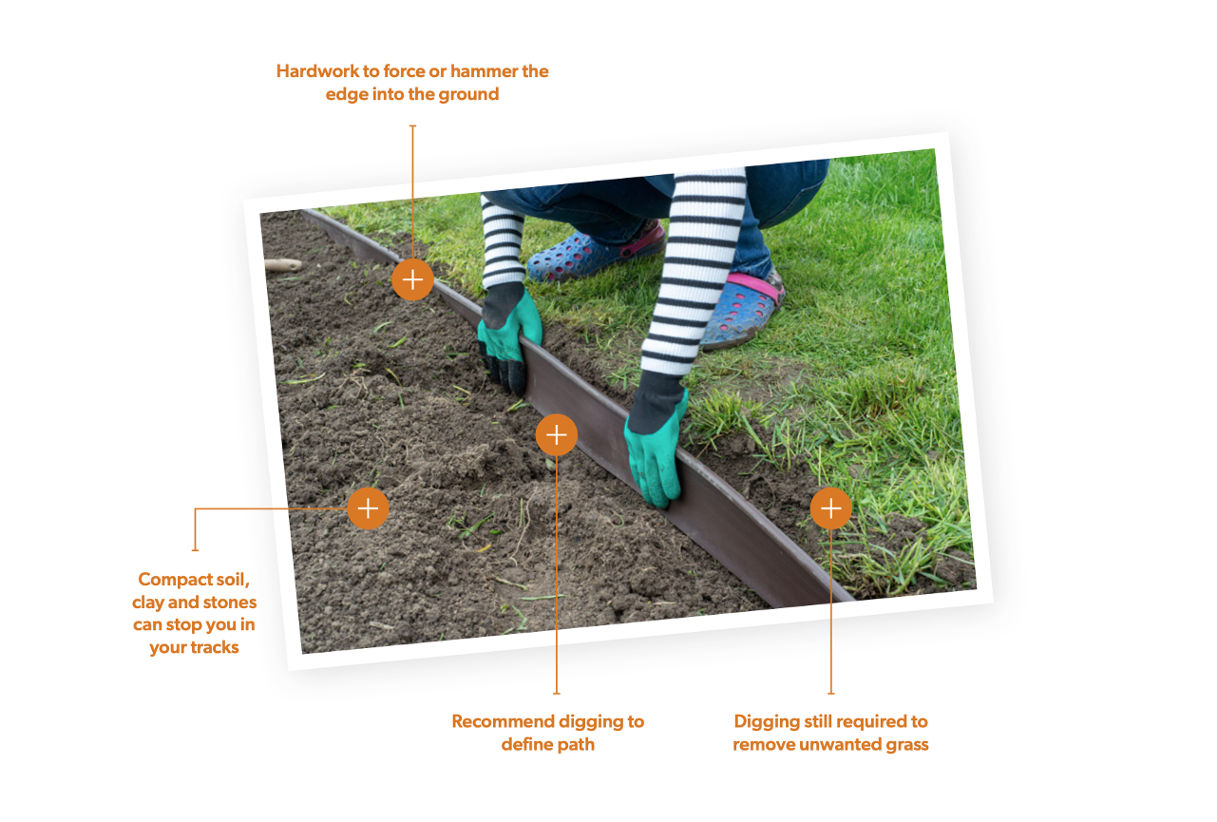
“No-dig edging” sounds like exactly what it says: an edging product you can install without breaking out a spade. In reality, it simply means the product is hammered directly into the ground rather than set into a trench.
That distinction matters more than most people realise. To install no-dig metal garden edging, you need to hammer it into the ground using a heavy mallet and a block of wood to prevent damage to the edge itself. In soft, freshly turned soil this is hard work. In compacted ground, clay, or an established lawn (all of which are extremely common in UK gardens) it becomes genuinely punishing, and getting the edge into a consistent line is close to impossible.
There’s also a deeper problem. No-dig edging is designed for soft soil, but many people want edging precisely to define the boundary of an established lawn. That means the grass and its root system are already in place, and you’ll need to remove a strip of turf and dig a trench anyway just to create a clean boundary. At that point, you’ve done the work that “no dig” was supposed to save you.
In summary: despite the name, no-dig edging often requires more physical effort than a conventional trench-and-set installation, and it gives you less control over the final result.
Pro Tip
Trench installation is easier than it sounds
A trench-and-set installation (the method used by Straightcurve) requires a spade and a few minutes of digging per metre. Once the edging is in the ground and staked, you can fine-tune the line before anything is fixed. No-dig edging offers no such adjustment once it’s in. If you value a clean, consistent edge, the trench method wins on both effort and result.
Myth 2: Bendable and flexible are the same thing
Most metal garden edging brands describe their product as “flexible.” Very few explain what that actually means in practice.
There is an important distinction between a product that is bendable (one that can be shaped with sufficient force) and one that is genuinely flexible: a product you can form into curves by hand, without tools, without skilled shaping, and without permanently stressing the material.
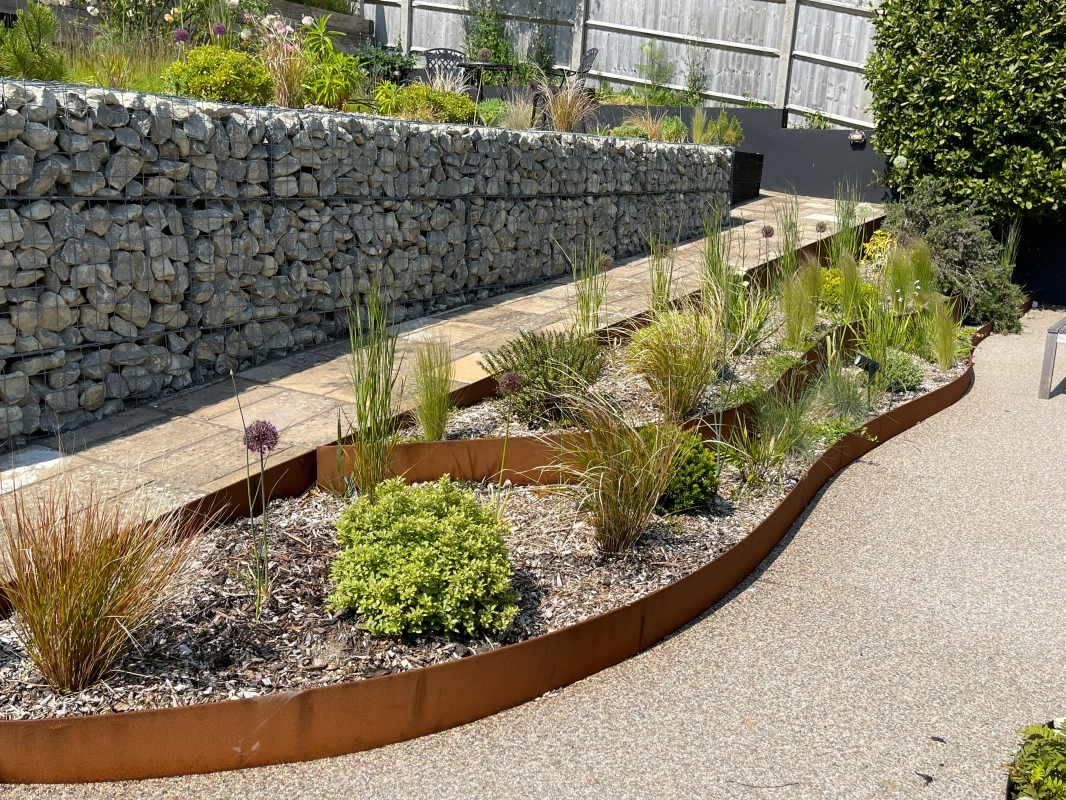
The difference becomes obvious when you’re trying to create a gentle flowing curve around a garden bed. With a product that is merely bendable, you need to pre-shape it, which requires practice, skill, and often a second person. Get it wrong and you’ve got a kink, not a curve. With genuinely flexible edging, you set the shape in the ground and the material follows.
There is also a design complication that most buyers don’t know about: edging with a rolled or folded top (which you want, because it eliminates the sharp edge hazard) is inherently harder to flex. Many manufacturers simply skip the rolled top rather than engineer around the problem. Straightcurve’s Flex range is designed specifically to offer both: a safe rolled top and genuine hand-flexibility, without requiring skilled installation.
Pro Tip
Test before you commit
If a supplier claims their edging is flexible, ask them to show you a radius. How tight a curve can it achieve by hand, without tools? A genuinely flexible product should be demonstrable in seconds. If the answer involves a bending jig, a heat gun, or the words “with a bit of practice,” it’s bendable: not flexible.
What 'easy to install' actually means
Almost every metal garden edging brand claims their product is easy to install. It’s the most meaningless claim in the category, easy compared to what? Installing a kitchen? Pouring a concrete path? These comparisons are useless.
The more useful question is: easy compared to other edging brands? To assess that honestly, look at how the product is designed to be installed, not what the marketing says about it. Five specific design features determine whether an edging product is genuinely easy to work with:
- Is it flexible or just bendable? Covered above, but it directly affects installation ease. An edge you can shape on-site, in the ground, with your hands, is always easier to install than one requiring pre-shaping.
- Pre-attached pegs benefit the manufacturer (simpler production, cheaper to ship) but make life harder for the installer. Each stake is fixed in position, which makes it difficult to create a consistent curve or straight line. They also cause problems when you encounter tree roots, rocks, or buried pipes, all common in established UK gardens.
- Does it have a rolled top? A rolled or folded top edge is a safety requirement, not a luxury. Unrolled steel edge is sharp. If the product doesn’t have one, that’s a design compromise, and it often signals the manufacturer didn’t engineer for genuine flexibility.
- How are the panels joined? The best metal garden edging can be joined securely before it goes into the ground, allowing you to lay out the full run, check the shape, and adjust before you commit. Products that can only be joined after installation make it far harder to achieve a clean, consistent line. Look for a purpose-built connection system, not just screws through pre-drilled holes, but ideally a system where the join is part of the product design. Note that most manufacturers do not pre-drill, you’d need to drill yourself, which adds time and requires the right tools.
- Some suppliers advertise a price per metre that excludes the stakes, connectors, and joining plates needed to actually install the product. These accessories can add 20–30% to the total cost. Always ask what is included in the stated price before comparing quotes.
Which material is right for your garden?
Steel garden edging in the UK is available in two primary materials: weathering steel (often referred to by the trade name Corten) and galvanised steel. They behave very differently in the ground, and choosing the wrong one for your conditions is a common and costly mistake.
Corten steel / weathering steel
Corten steel, also called weathering steel, develops a distinctive rust-coloured patina over time. This patina is not ordinary rust, it is a stable oxide layer that forms through repeated wet-dry cycles, which slows further corrosion and gives the material its characteristic appearance. The UK’s temperate maritime climate (with its consistent rainfall and dry spells) is actually well-suited to weathering steel patina development. This is a genuine advantage for UK gardens that is often overlooked.
Weathering steel is the right choice for well-drained inland gardens, and performs beautifully in the UK’s temperate climate. For coastal environments within approximately 2km of the sea, or areas with high salt or chloride exposure, patina formation can be affected, galvanised steel is worth considering as an alternative for those specific conditions. With the right care, weathering steel can still perform in more demanding environments; see our Product Care and Longevity Guides for detail.
One important note: weathering steel is not “rust resistant.” It manages corrosion through controlled patina formation, that is a different mechanism entirely. Any product described as “rust-resistant corten” should be treated with scepticism.
Galvanised steel
Galvanised steel is coated with zinc, which provides a protective barrier against corrosion. It is the better choice for coastal gardens, areas with heavy clay soils, or anywhere with poor drainage and constant ground moisture. It is also worth noting that zinc protection can degrade more quickly in highly acidic soils (common where compost-rich or organic beds are in use) so installation depth and drainage conditions matter.
10 questions to ask before you buy
If you purchase the wrong metal garden edging, you could end up spending hundreds of pounds and finding yourself replacing it within a few years. The questions below will help you evaluate any brand objectively before you commit.
Ask these of any supplier and compare their answers with what you’d expect from a well-engineered product.
- Is the edging genuinely flexible, or just bendable? Genuinely flexible edging can be shaped by hand without tools. If the answer involves pre-shaping, bending jigs, or “a bit of practice,” it’s not flexible.
- Does the edging have a rolled or folded top edge? A rolled top eliminates the sharp-edge hazard and indicates higher manufacturing quality. If the top is unfinished, ask why, and consider whether it’s safe for a garden used by children or pets.
- How is the edging installed — trenched or hammered? Trench-and-set installation gives you control over the line and the ability to adjust before fixing. Hammer-in installation offers limited adjustment and requires soft soil to work effectively.
- Are the stakes pre-attached or separate? Pre-attached stakes reduce flexibility during installation and make routing around roots and underground obstacles harder. Separate stakes give you far more control.
- How are panels joined together? The best products can be joined before installation using a purpose-built connection system. If joining requires post-installation work or relies on DIY screws through unmarked holes, it will be slower and less consistent.
- What’s included in the price per metre? Confirm whether stakes, connectors, and joining plates are included. If sold separately, calculate the full cost per metre before comparing.
- Is the product pre-drilled? Most manufacturers do not pre-drill. If the product requires drilling on-site, factor in the time, tools, and skill required.
- What gauge (thickness) is the steel? Thicker gauge steel lasts longer. Ask for the actual thickness in millimetres. A credible supplier will answer this directly.
- Which material is right for my garden conditions? The right answer depends on your garden. Weathering steel suits well-drained inland gardens; galvanised suits coastal, clay, or wet conditions. If a supplier doesn’t ask about your conditions before recommending a material, that’s a warning sign.
- What warranty do you offer? A credible manufacturer backs their product. Ask for the warranty in writing and confirm what it covers — the steel, the coating, or the full installation performance.
For full product details and pricing from Straightcurve, request a price list or browse the garden edging range online.
Pro Tip
Put the answers in writing
If a supplier’s claims are hard to verify online, ask for them in writing before ordering. A reputable brand will have no hesitation confirming steel grade, gauge, warranty terms, and what’s included in the price. Reluctance to confirm specifics in writing is itself useful information.
Ready to take the next step?
Choosing the right metal garden edging comes down to three things: understanding what the marketing claims actually mean, knowing the difference between the two main material options, and asking the right questions before you spend anything.
Straightcurve steel garden edging is designed to address every point in this guide, genuinely hand-flexible panels, a safe rolled top, a purpose-built connector plate joining system, separate stakes for full installation control, and all connectors included in the price per metre. It’s available in both weathering steel (corten) and galvanised steel to suit your specific garden conditions.
To see the full range and get pricing, request a price list, shop Straightcurve metal garden edging online, or see it in real UK gardens.
Common questions about metal garden edging
Is no-dig metal garden edging any good?
No-dig edging works in one specific condition: soft, freshly turned soil. In most UK gardens (particularly those with clay, compacted ground, or established lawns) it requires significant hammering effort and gives poor results. For a clean, consistent edge, trench-and-set installation gives you more control and is generally less physically demanding overall.
What is the difference between corten steel and galvanised steel garden edging?
Corten steel (also called weathering steel) develops a stable rust-coloured patina through wet-dry cycling, which slows further corrosion. It suits well-drained inland gardens and performs beautifully in the UK’s temperate climate, and remains the most popular choice for its distinctive natural character. Galvanised steel has a zinc coating that resists corrosion from moisture and salt, and is worth considering for coastal gardens, clay-heavy soils, or areas with poor drainage. The right choice depends on your conditions and aesthetic preference. Our Longevity Guide and Product Care Guide cover detailed guidance on material selection and care in coastal and challenging conditions.
How long does metal garden edging last in the UK?
Lifespan depends heavily on material, installation conditions, and aftercare. In favourable conditions (well-drained inland soil, correct installation depth, regular top-up of surrounding soil) quality weathering steel edging can last well beyond a decade. Galvanised steel generally lasts longer still in the buried section. In challenging conditions (coastal, acidic soil, constant moisture) lifespan can be significantly shorter. Choosing the right material for your conditions is the single biggest factor. Our Longevity Guide and Product Care Guide cover detailed guidance on maximising lifespan in coastal and challenging conditions.
What thickness should metal garden edging be?
For residential garden use, 1.5mm–3mm is the typical range. Thicker gauge steel is more rigid, more durable, and better suited to use as raised bed walls or retaining applications. For in-ground lawn edging, 1.5mm–2mm is usually sufficient. Always ask the supplier for the actual gauge in millimetres, “heavy duty” is not a specification.
Do I need extra stakes and connectors when buying metal garden edging?
This varies by brand. Some suppliers include stakes and connectors in the stated price; others sell them separately, which can add 20–30% to the total cost. Always confirm what is included before comparing prices across brands.